
September 2025 Edition: Global Summit 2025 Around the Corner, Doctors AI Expands Collaborations, and More!
Monthly Newsletter of the DoctorsAI Community


Doctors AI Global Summit 2025
Register as ICAIM Member: https://rzp.io/rzp/0I9cPmb
Register as Non-ICAIM Member: https://rzp.io/rzp/CYn1V6HS
This summit offers a focused platform for deep dives into AI applications, networking with innovators, and direct engagement with leaders in the field.
Doctors AI at IIM Ahmedabad: Bridging Clinicians and Innovators

Dr. Shelly Sharma, Advisory Board member at Doctors AI, represented the organization on behalf of Dr. Avneesh Khare, Advisory Board Chair, at the Responsible AI Innovation in Healthcare Summit held at IIM Ahmedabad on October 9-10, 2025. The summit featured a closed-door roundtable, “Clinicians & Innovators – Bridging the Gap,” fostering candid dialogue among clinicians, innovators, researchers, and policymakers on aligning AI with real-world clinical needs.
The roundtable emphasized understanding workflow realities, adoption barriers, and building trust in AI systems, highlighting the crucial role of frontline healthcare providers in shaping policy and product development. DoctorsAI’s participation reinforces its commitment to facilitating dialogue between clinical practice and technological innovation, ensuring AI solutions are usable, trustworthy, and safe in healthcare settings.
Key Takeaways:
AI must learn empathy, not just data.
Collaboration between clinicians and innovators turns ideas into real-world impact.
The future lies in “man with machine,” where AI supports, not replaces, human judgment.
The aim is AI that’s not only intelligent, but responsible and purposeful.
Doctors AI Update Hour: Global Insights on Responsible AI in Healthcare
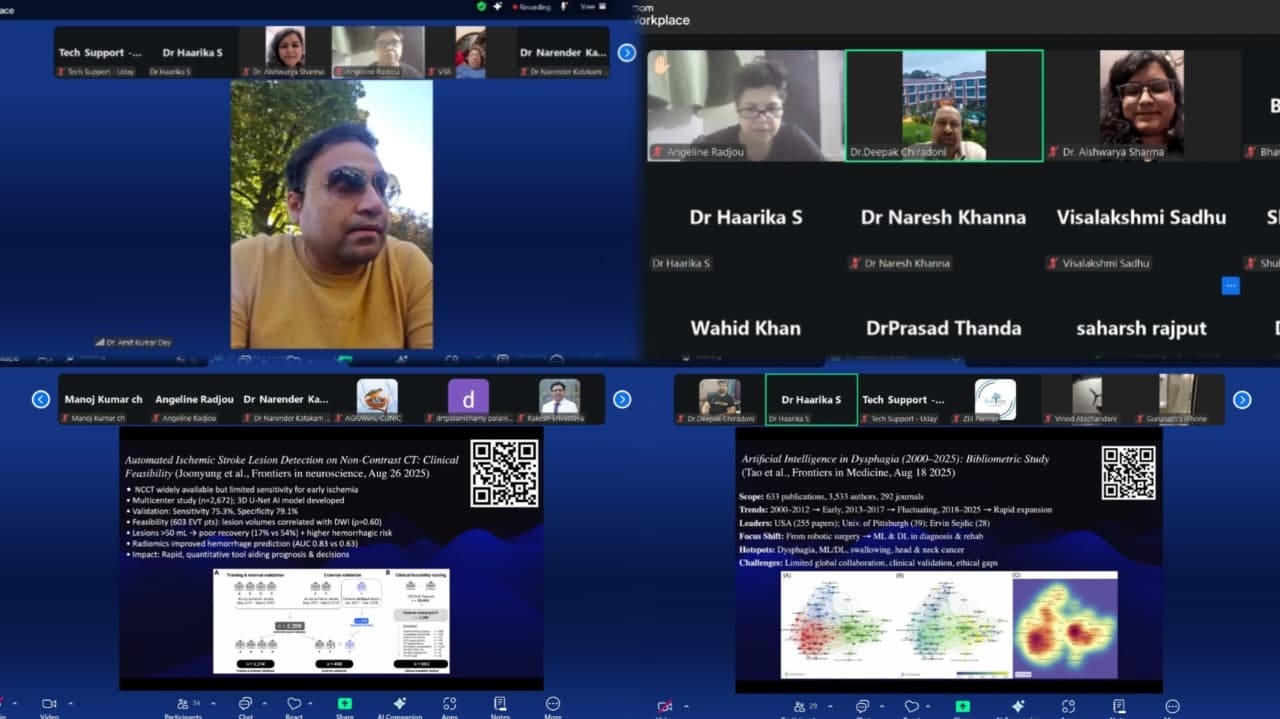
Presented by Dr. Haarika Sadhu, and moderated by Anirudh Gangadharan, this session featured Dr. Amit Kumar Dey (Founder - DoctorsAI, ICAIM, and Chair- AI Technology Committee wing International Diabetes Federation) joining us from Geneva.
Global Developments: High-level discussions in Geneva (WHO, IDF, FIND, ITU, ministries) focused on responsible AI in healthcare, emphasizing patient-centric AI, data protection, and capacity-building in medical education. India’s AI education efforts received encouraging global recognition.
Research Highlights:
AI in Stroke Care: 3D U-Net model detects ischemic lesions on NCCT, improving early diagnosis.
AI in Practice Management: Workflow optimization in cardiology reduced wait times and improved efficiency.
AI & Dysphagia: Rapid research growth, but limited global collaboration and clinical validation.
Bias in LLMs: Studies highlighted risks of sycophancy and position bias in sensitive contexts (e.g., LGBTQ+ care).
LLMs for Hospital Summaries: AI-generated notes were more concise and cohesive, though hallucination risks remain.
Drug Discovery: AI accelerates timelines (e.g., AlphaFold, Atomwise, BenevolentAI).
Ethics & Governance: Stronger guardrails urged; FAIR AI framework proposed for accountable evaluation.
Drug Safety: GPT-4 shows promise in extracting safety data from structured labels, streamlining pharmacovigilance.
Discussions: Project NANDA’s potential to decentralize Healthcare AI, the emergence of open-source multimodal LLMs like SophontAI-Deepseek as a healthcare AI game-changer, and entry pathways into AI research and data science using Orange were discussed.
Key Takeaways: Validation in local contexts is critical, ethics and safety must evolve alongside innovation, and collaboration among doctors, engineers, policymakers, and patients is essential. India’s initiatives are gaining global attention, carrying both strong momentum and high responsibility.
MedAI Webhour Ep 10: AI in Public Health & Genomics
This session, moderated by Dr. Aishwarya Sharma, featured Dr. Kaushik Mitra on AI in Public Health and Dr. Kamal Deep Chawla on AI in Genomics.
AI in Public Health (Dr. Koshik Mitra):
Applications: Disease surveillance (real-time data, forecasting, NLP, climate-smart surveillance), epidemiological modeling, health resource optimization (predictive demand, smart supply chain, workforce allocation), and imaging/diagnostics (early detection, multimodal diagnostics).
Indian Initiatives: AI centers of excellence in Delhi PGI Chandigarh and Rishikesh; AI in media disease surveillance and e-Sanjeevani.
Barriers & Solutions: Lack of training (hands-on programs), inadequate infrastructure (cloud platforms), technical expertise shortage (interdisciplinary teams), and ethical challenges (systems thinking, community engagement).
AI in Genomics (Dr. Kamal Deep Chawla):
Fundamentals: Genomics involves vast data, analyzed using ML, Deep Learning, NLP, and Computer Vision.
Applications: Gene sequencing (faster, cheaper, more accurate), disease prediction (polygenic risk scores), and drug discovery.
Precision Medicine: AI-driven genetic profiling, risk assessment, treatment selection (e.g., PCSK9 inhibitors vs. statins), and outcome prediction.
Explanable AI (XAI): Crucial for transparency, causality, bias detection, and trust in clinical adoption.
Challenges: Need for large, diverse datasets; privacy, regulatory issues, and bias.
Emerging Trends: Federated learning, multimodal integration, real-time analysis.
Gene Sutra (Example): Dr. Chawla’s brand uses a Valetics AI engine to unify genomic, medical, and lifestyle data for reports on disease predisposition, pharmacogenomics, nutrigenomics, and rare variant analysis, with data ownership by individuals.
Journal Club: AI, EMR, and Precision Healthcare in Endocrinology
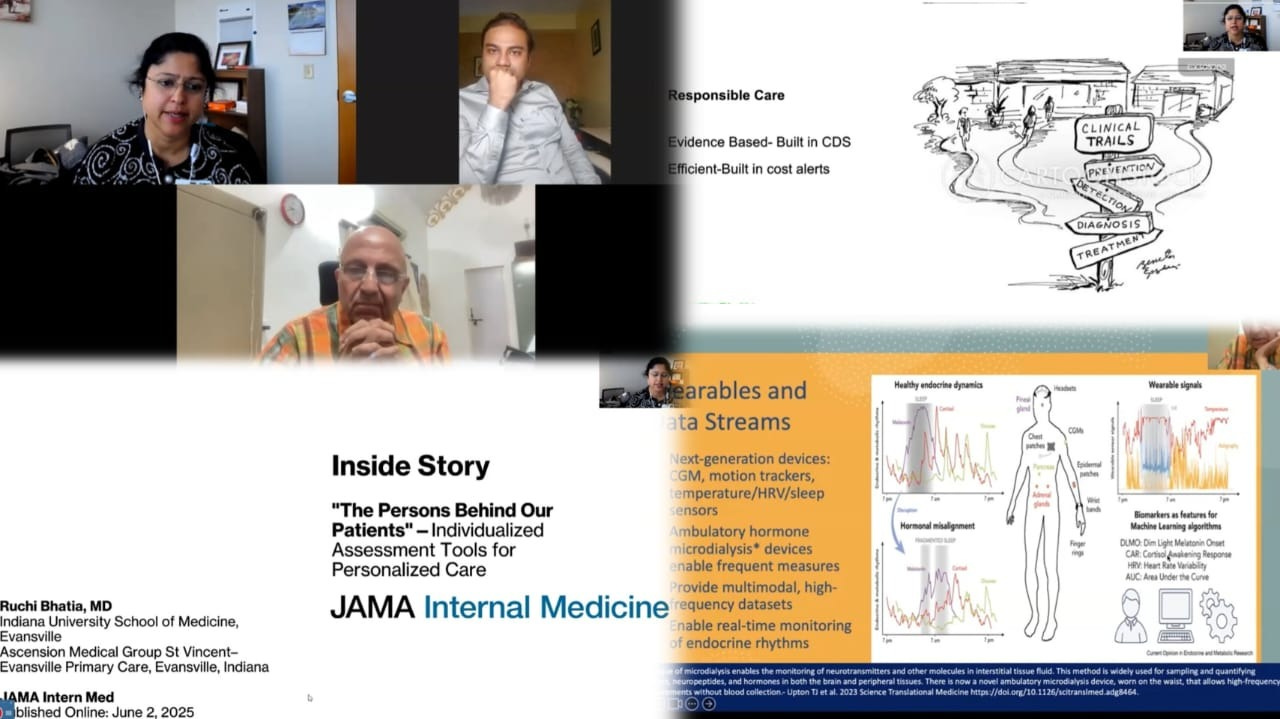
Presented by Dr. Ruchi Bhatia and Dr. Vinod Abhichandani,this Journal Club focused on the role of AI in modern healthcare documentation and its specific application in endocrinology.
Digital Healthcare Context: Western healthcare’s third-party managed care system is highly standardized, benefiting from decades of digital record-keeping. The shift to population health requires new standardization layers, but EMR templates create “click burden” and can lead to “standard blind spots” that limit patient understanding.
AI Opportunities: AI can address missing context (e.g., loneliness impacting memory), surface hidden patterns from wearables, and contribute to an AI-augmented learning health system. Ambient AI offers solutions for reducing friction but raises concerns about physician scrutiny.
AI in Digital Endocrinology: Endocrinology is well-suited for AI due to dynamic hormone regulation.
Challenges: Data issues (high dimensionality, heterogeneity, bias), technical hurdles (lack of standardized tools, infrastructure), and clinical translation (interpretability of results, “blackbox results”).
Advanced Data & Modeling: Next-generation devices (CGM, motion trackers, ambulatory hormone micro dialysis) provide high-frequency data. Mathematical modeling and endocrine digital twins are powerful tools for understanding and predicting hormonal regulation.
Diagnostic & Management Tool: AI detects subtle hormone patterns, analyzes imagery with high precision, recommends personalized dosing, and identifies computational biomarkers.
Conclusion & Future Directions: Interoperability and customization are key challenges. The future of medicine involves computational medicine, requiring algorithms co-built with clinicians. Clinicians must embrace AI and collaborate with mathematicians and statisticians to ensure patient-preferred and patient-centric healthcare.
Decoding AI in Healthcare Series, Podcast: AI in Revenue Cycle Management
Learn how Artificial Intelligence is transforming healthcare operations, optimizing revenue cycle management, and paving the way for a smarter, more efficient future in medicine.
Speakers: Dr. Dipu Patel (Digital Health Consultant & AI Entrepreneur, USA), Dr. Amit Kumar Dey (Founder Chair, DoctorsAI | Founder, ICAIM), Dr. Vijayashree Natarajan (Chief Technology Officer, Omega Healthcare, India).
Key Takeaways: Real-world AI applications in revenue cycle management, challenges & opportunities in adoption, and the future roadmap for AI-driven healthcare finance.
📝 Stay Updated and Engaged - To receive tailored updates and opportunities for collaboration, please consider filling out our Community Directory Form. By participating, you'll ensure you're at the forefront of our community initiatives and collaborations.
If you've found value in this newsletter, please subscribe and share it with your colleagues.
Together, let's continue to pioneer the integration of medical professionals-led AI into healthcare, shaping a future where technology and human expertise create a healthier world for all!
|
 | A guest post by
|
 | A guest post by
|